Stuart Davis
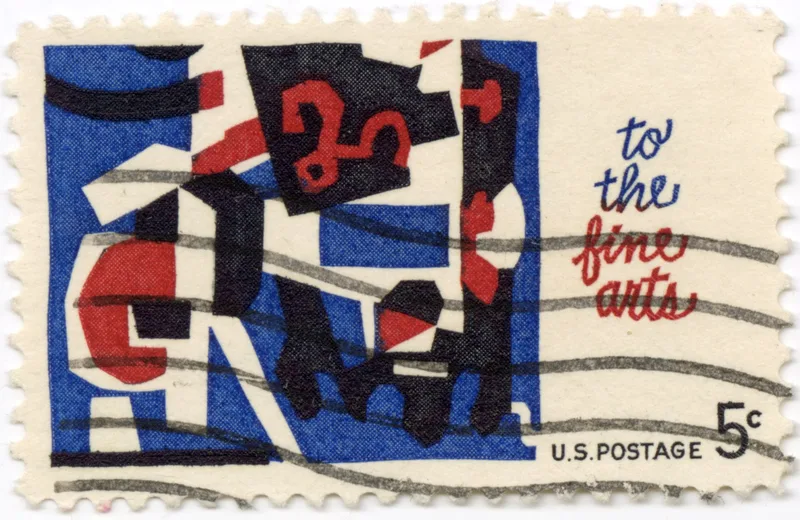
Stuart Davis (December 7, 1892 – June 24, 1964) was an American painter, printmaker, and muralist, regarded as one of the leading figures of American modernism. Trained under the realist painter and teacher Robert Henri, he exhibited in the 1913 Armory Show and went on to develop a personal form of cubism. His paintings pair flat, hard-edged color with imagery and lettering drawn from advertising, city streets, and jazz. In the 1930s he painted murals for federal art programs and led artists’ organizations. He also worked as a magazine illustrator, and his design for the 1964 Fine Arts stamp was the first abstract design on a United States postage stamp.12345
Art critic Karen Wilkin describes Davis as a home-grown cubist whose work belongs to no single movement. He called his method “Color-Space,” using flat, sharply bounded areas of color to set up spatial relationships. In a 1956 television interview, he rejected the abstract label and called his work realist because it recorded his full awareness of an experience. Lettering appeared in his paintings from the early 1920s and became central to them after 1949. From 1939 on, he rarely made a painting that did not rework an earlier composition. Wilkin sums up this practice with his phrase “the Amazing Continuity.” Among the things that made him want to paint, he named gas stations, taxicabs, electric signs, and the jazz of Earl Hines. His notable works include Lucky Strike (1921) at the Museum of Modern Art in New York and The Mellow Pad (1945–51) at the Brooklyn Museum.12467
Davis was born in Philadelphia to parents who had both studied at the Pennsylvania Academy of the Fine Arts. His mother, Helen Stuart Foulke, was a sculptor. His father, Edward Wyatt Davis, was art director of The Philadelphia Press. His staff there included John Sloan, George Luks, and William Glackens, later members of The Eight, a group of painters led by Henri. In 1901 the family moved to East Orange, New Jersey. In 1909 Davis left high school to study with Henri in New York. From 1912 he drew covers and cartoons for The Masses, a socialist magazine. The next year he showed five watercolors at the Armory Show and was one of its youngest exhibitors. By his own account, the show was the greatest single influence on his work.13467
Davis spent most summers in Gloucester, Massachusetts, from 1915 to 1934. In 1927 he nailed an eggbeater, an electric fan, and a rubber glove to a table and painted them for a year. He later said that all his subsequent work grew from this Egg Beater series. Purchases by the Whitney Studio Club paid for a stay in Paris from June 1928 to August 1929. In 1932 he painted the mural Men Without Women for Radio City Music Hall. From the end of 1933 he worked for New Deal art programs. His murals for them included Swing Landscape (1938) and a 1939 mural for the radio station WNYC. He also served as president of the Artists’ Union. The Museum of Modern Art held a Davis retrospective in 1945. In 1952 he was one of four artists chosen for the U.S. pavilion at the Venice Biennale. The Abstract Expressionists later overshadowed him, but he drew renewed attention with the rise of Pop art.13467
The U.S. Post Office Department issued the 5-cent Fine Arts stamp on December 2, 1964, about five months after Davis’s death. Its design came from his 1957 color lithograph Detail Study for Cliché. That print developed from his 1955 painting Cliché, now at the Solomon R. Guggenheim Museum in New York. Davis often made such detail studies, testing new color schemes for sections of larger works. For the stamp, the image was slightly modified and the words “To the Fine Arts” were added. The design won a national competition and became the first abstract design on a U.S. postage stamp. Postmaster General John A. Gronouski dedicated it at the National Gallery of Art in Washington, D.C. The Bureau of Engraving and Printing printed about 125.8 million copies in ultramarine, black, and dull red. It used a Giori press, which prints several colors from engraved plates in one pass.45689107
References 10
- ↑ Stuart Davis. National Gallery of Art. Accessed October 13, 2026.
- ↑ Stuart Davis: In Full Swing. Whitney Museum of American Art. Accessed October 13, 2026.
- ↑ Stuart Davis. Terra Foundation for American Art. Accessed October 13, 2026.
- ↑ Stuart Davis (painter). Wikipedia. Accessed October 13, 2026.
- ↑ Stuart Davis, Detail Study for “Cliché”, 1955. Schoelkopf Gallery, April 9, 2020. Accessed October 13, 2026.
- ↑ Karen Wilkin, Lewis Kachur, Wayne L. Roosa, Rudi Fuchs, Federica Pirani. Stuart Davis. Peggy Guggenheim Collection; Boston: Little, Brown (Bulfinch Press), January 1, 1997. Accessed October 13, 2026.
- ↑ James Johnson Sweeney. Stuart Davis. Museum of Modern Art, New York. Accessed October 13, 2026.
- ↑ Detail Study for Cliché. Philadelphia Museum of Art. Accessed October 13, 2026.
- ↑ John A. Gronouski. Address by John A. Gronouski, Postmaster General, at dedication of fine arts stamp, National Gallery at Art, Washington, D.C., Dec. 2, 1964.. Post Office Department, via Monthly Catalog of U.S. Government Publications (University of North Texas Libraries), December 2, 1964. Accessed October 13, 2026.
- ↑ 1964 5c Fine Arts. Mystic Stamp Company. Accessed October 13, 2026.
Wikipedia entry
Edward Stuart Davis was an American modernist painter. He was associated with early twentieth-century American modernism, including the Ashcan School, and later developed a style characterized by bold color, jazz references, and urban subject matter. In the 1930s, Davis became politically active and participated in federally sponsored art programs during the Great Depression.
Information from Wikipedia, made available under the Creative Commons Attribution-ShareAlike License. Accessed October 12, 2026.